Resource List From Why Words Matter Series
This page has materials and resources from our "Why Words Matter" webinar series.
Quality Assurance, The Regional Quality Councils, and Regional Capacity Building Networks hosted a lunch and learn series. They organized it due to the resurgence of the R Word and other ableist language. This series aimed to address and discuss these important issues.
Words matter more than you might think. How we talk to others in daily conversations can have a lasting impact on those around us.
In this series, we explored how language shapes attitudes and beliefs. We also discussed outdated words and phrases that can be harmful, and why some words are no longer appropriate. We explained how language can unintentionally reinforce stereotypes. We also identified more inclusive and respectful ways to communicate.
Click here to view a YouTube Playlist with recordings of this 5-part webinar series.
Presentations
September 2nd: History of the R-Word and its recent resurgence
With Tony Anderson
Tony is the Associate Director at the Association of Regional Center Agencies (ARCA). California's regional centers are a network of 21 community-based non-profits, represented by the Association of Regional Center Agencies (ARCA). The regional centers coordinate services for, and advocate on behalf of, approximately 450,000 Californians with developmental disabilities. Tony is the author of an article in the Frontline Initiative titled: Lessons from the Frontline Learned Across Thirty Years. Tony's presentation was based on thoughts from this article, and discussed the History of the R-Word and its recent resurgence.
September 9th: The Power of Language
With Stacy Danov
In our second session, we were joined by Stacy Danvov, PhD LP. Stacy is a state leader in Positive Supports and works for the Department of Human Services as a Clinical Coordinator in the Disability Services Division. Stacy's training topic was The Power of Language: How the words we use shape people, practice, and power. This interactive session challenged participants to think critically about the words they use.
September 16th: Why Words Matter-Lived Experience Insights
With Elizabeth Miller, Meredith Kujala, Julianne Roberts, Addie Loerzel
In our 3rd session, people with disabilities shared their lived experience insights with us. They answered questions like:
- What does respectful language mean to you?
- Can you share a time when language make you feel excluded, underestimated, or misunderstood?
- When you hear hurtful words like the R-word, how does that make you feel?
September 23rd: Why Words Matter-Professional Insights
With Mai Thor, Amanda Crosby, Rep. Kim Hicks
In our 4th session, disability professionals shared their insights with us. They answered questions like:
- When you hear someone dismiss concerns about language as "just words" or say people are being too sensitive, how do you respond?
- Why is it important to recognize that disabled people may have different language preferences?
- How have you seen the way professionals talk about people with disabilities change over the course of your career?
September 30th: Interactive Discussion and Breakout
With Randall Oldenburg and Shelly Rohe
In this final session of our series, we were joined by Randall Oldenburg and Shelly Rohe. These powerhouse self-advocates are heavily involved with the Regional Capacity Building Networks and Region 10 Quality Council respectively. They shared insights with us and we had an interactive discussion in large and small groups.
Resources and Get Involved
If you want to get involved in this area or other related issues, consider the following resources:
- Learn about why language matters and how we can do better in This Article
- Learn about the R word history and why it's a slur in This Article
- Learn how to talk to your friends about the R word with this Guide for Students and Parents
- Learn about how to advocate for disability rights with this Advocacy Toolkit
Contact Us if you have additional questions about this series, or to learn about other ways you can get involved.
Sign up for our Newsletter Here to get notified of our next series and get other updates from us.
Impact
Impact Report Coming Soon!
Check back later for the series report to find out more about the impact of this training series.
Positive Supports Activity Books
Make Positive Supports fun with our Activity Books!
These activity books were created in partnership with the Quality Assurance Commission. They are a fun way to reflect on your life and goals with a Positive Supports lens.
The books are free to download and print.
Resource list from Supported Decision Making Series
This page includes materials and helpful resources mentioned in our Supported Decision Making webinar series.
The Regional Quality Councils and Regional Capacity Building Networks hosted a lunch and learn series to talk about the variety of supports someone can receive to help them make decisions.
Every person and family has a unique path. The series provides information and resources so people can make the decisions that are right for their situation. There is a continuum of support, from informal help from family and friends, to formal tools and legal supports. Each person may need different types of support at different times in their life.
There were a variety of perspectives and experiences from presenters/panelists, including people with disabilities, family members, and professionals who have expertise in this area.
Click here to view a YouTube Playlist with recordings of this 4 part webinar series.
Presentations
February 6th: General Overview
The first session in the series was a general overview of Supported Decision Making and Guardianship. Attendees received information about the wide range of ways to support people in making decisions. The session was led by Anita Raymond, from the Center for Excellence in Supported Decision Making.
Supported Decision Making Graphic
February 13th: Self Advocate and Parent Panel
In this session we invited people with disabilities and their family members to share their lived experiences in decision making. We explored who makes decisions in each family, what supports are needed to make informed decisions, what happens if there are disagreements, and more!
February 20th: Special Education with and without guardianship
This session focused on what happens when a student receiving special education in Minnesota turns 18. The Minnesota Department of Education explained the ‘age of majority’ and transfer of rights. Wendy Fritz, a transition facilitator with Detroit Lakes Public Schools, shared her experience supporting students who are their own guardians as well as those with guardianship.
February 27th: Legal considerations
This session started with an overview of the Guardianship Bill of Rights and explore the legal process, considerations, and potential challenges for someone under guardianship who wants to have it ended. The session was led by Rebecca Wanous and Natalie Bielenberg from Autism Advocacy and Law, who shared practical insights and answered questions.
Get Involved
If you want to get involved in this area or other related issues, consider the following resources:
Join us on April 29th for Disability Day at the Capitol
Check out the West Central Transition Checklists/Resources. Hint: There is a section on Guardianship and Supported Decision Making.
View this guide to Preparing for Adulthood: A Parent’s Guide to Independence
Learn about how to advocate for disability rights with this Advocacy Toolkit.
Contact Us if you have additional questions about supported decision making, or to learn about other ways you can get involved.
Impact
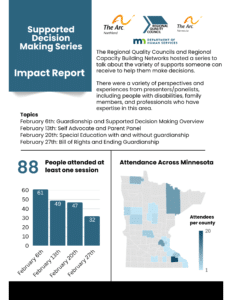
Across this four part series, 88 people attended at least one session. Our lowest attended session had 32 attendees and our highest had 61. Overall, each session had a positive response from participants.
Check out the series report to find out more about the impact of this training series.
Resource list from Eliminating Subminimum Wage Series
This page includes materials and helpful resources mentioned in our webinar series: Eliminating the Subminimum Wage Series: Real Wages for Real People!
Click here to view a YouTube Playlist with recordings of this 5 part webinar series.
Presentations
Slide decks from the presentations can be found here:
April 1st: John Sherman, Early Minnesota Subminimum Wage Transformation: From The Last Millennia To The Next
April 1st: Brian Begin, Employment First: Federal and State Policies
April 22nd: Amanda Crosby, Empowered Through Knowledge: Balancing Work and Benefits
April 29th, Tina Rucci, Legislative Update
Get Involved
If you want to get involved in this area or other disability policy areas, consider the following resources:
Join us on May 3rd at the Protect our Future Rally for Disability Funding.
Join a Capitol Connector Team in your area.
Learn about how to advocate for disability rights with this Advocacy Toolkit.
Contact Us if you have additional questions about subminimum wage, or to learn about other ways you can get involved.
Impact
Across this five part series, 101 people attended at least one session. Our lowest attended session had 48 attendees and our highest had 65. Overall, each session had a positive response from participants.
Check out the series report to find out more about the impact of this training.

Regional Quality Council Newsletter February 2024
News from the Minnesota Regional Quality Councils. Learn about projects from the four RQCs.
2022-2023 Regional Quality Council Bi-Annual Report
Learn about the RQC history, workplan, and what we accomplished in 2022-23.